
Bus Simulator Ultimate Terminals and Offices: Location and Strategy Guide (2026)
Unlocking a country and building a functional terminal are two different things. The gold spend opens the door. What you do inside that door, the office upgrades, the capacity expansions, the amenity investments, determines whether the terminal earns its keep or just sits on the map looking busy. A surprising number of players unlock a country, see it turn green on the world map, and never actually build anything in it.
This guide covers what terminals actually are in Zuuks Games‘ transport simulation, the step by step buying process, which upgrades matter and which you can skip, how office quality connects to passenger demand, multi-terminal strategy for scaling your company, and a rough cost versus revenue framework for judging whether a new terminal is worth it before you buy
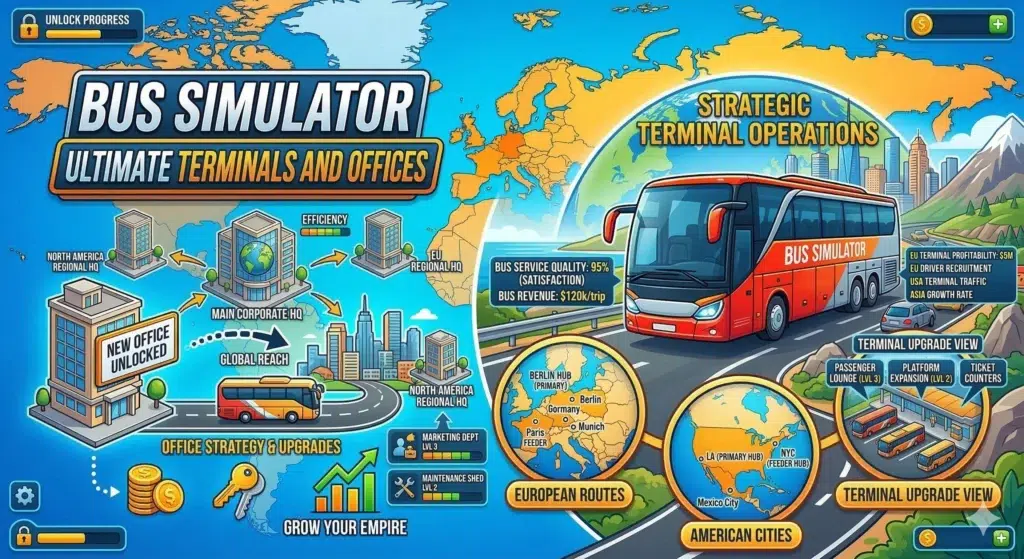
What Are Terminals in Bus Simulator Ultimate?
Terminals are the physical bases of your bus company in each city. They are the hubs where your routes depart from, where hired drivers begin and end their runs, where waiting passengers gather, and where your company has a visible presence in each country. Without a terminal in a city, you cannot operate routes from that city and your drivers cannot use it as a base.
The Terminals section in the main menu displays all available countries on a world map, unlocked countries show in green, locked ones in red. Each country contains multiple cities, and each city has its own terminal you can activate. Not every city within an unlocked country is free. Some require a coin payment even after you have already spent gold on the country unlock.
A properly set up terminal gives you a departure point for routes in that city, a waiting area for passengers that grows with upgrades, a satisfaction modifier based on the amenities installed, and a base for any hired driver assigned to routes in that region. The terminal is infrastructure, not just geography, and it is worth treating it that way.
Terminals vs Offices: What’s the Difference?
The terminal is the country-level structure, the overall presence your company has in a nation, unlocked with gold coins. The office is the city-level facility within that country, the specific building in a specific city where passengers wait and routes operate. One country can contain multiple offices across multiple cities. Upgrading an office improves that city’s capacity and amenities, while unlocking the terminal itself is what affects the country’s overall route availability and driver assignment capability.
How Do You Buy Terminals?
The buying process happens in three steps, and the second step is where most confusion comes from.
- Open the Terminals section from the main menu. The world map displays all countries with color coding, green for owned, red for locked.
- Select a locked country and tap Unlock. This costs gold depending on the country. Your first country is free when you start the game. This step opens the country and shows its available cities, but it does not yet create an active terminal.
- Select a city within the unlocked country and purchase an office. Some cities have a free starter office, others charge coins depending on city size and demand tier. This office purchase is what creates an active terminal, and it is also the step that triggers the “Discover Country” career objective. The objective does not register on the gold spend, only on the office purchase.
One detail worth knowing: terminal upgrades themselves are paid for with regular coins, not gold. Gold is reserved for unlocking new countries. Every upgrade decision after the initial country unlock is funded by your route earnings, which means your coin reserves, not your gold reserves, determine how fast your terminals actually develop. The full objective trigger sequence and gold sources are covered in the career mode guide.
Which Terminal Locations Are Worth Prioritizing?
Location strategy matters more than most players give it credit for. The country-level reasoning behind why Turkey, Brazil, India, and Russia rank the way they do is covered in full in the countries guide and the best routes guide. What follows here is the terminal-specific side of that decision: which city to build in first within each country, and what the office costs actually look like.
Istanbul, Turkey: Best First International Terminal
Istanbul’s starter office is relatively affordable, and the Istanbul to Ankara route gives it strong coins-per-hour potential right away. It also works well as a passive driver base, since the route completes frequently enough to generate a steady return cycle. This is generally the terminal that pays for itself fastest after your starting country.
Sao Paulo, Brazil: Best for Passenger Volume
Sao Paulo carries some of the highest passenger volumes in the game across multiple route tiers. The office costs more than Istanbul’s, but it tends to generate strong passive income once several drivers are running routes from it simultaneously. If your strategy leans toward a large passive fleet rather than active grinding, this is a reasonable second terminal.
Sacramento, USA: Best Starting Terminal
Since the USA is a free starting country, Sacramento requires no gold at all. It anchors the Sacramento to San Antonio route, a strong early-game earner, and the starting office here is free. Upgrading it early, parking space and passenger capacity first, turns Sacramento into the coin engine that funds your subsequent terminal purchases. A fully upgraded Sacramento office can outperform a bare-bones international terminal in the first week, so it is worth not neglecting in favor of chasing something new.
Mumbai or Delhi, India: Best Late-Game Terminal
India’s country unlock is the most expensive in the game, and its routes demand real driving skill. The payoff is real for players who wait until they have enough experience and a couple of strong drivers already running efficiently. Building this terminal earlier than that tends to underperform relative to its cost.
Vladivostok, Russia: Best for Distance Objectives
Russia’s terminal earns its place for one specific purpose: completing distance-based career objectives quickly through the Vladivostok to St. Petersburg run, the longest single route in the game. For general earnings it underperforms Turkey and Brazil, since the route length limits how often it completes, but for objective progress it is hard to beat.
Which Terminal Upgrades Actually Matter?
Every terminal office has an upgrade menu, and not every option there carries equal weight.
| Upgrade | Priority | Effect |
|---|---|---|
| Parking Space | First | Increases how many buses can depart simultaneously, directly scaling earnings capacity |
| Passenger Capacity | First | More waiting passengers per terminal, so every departure carries a fuller bus |
| Restroom | Second | Improves waiting passenger comfort, reducing the satisfaction penalty from long waits |
| Cafe or Restaurant | Second | A further comfort upgrade that raises how passengers rate the departure experience |
| Security and Cleaning Staff | Third | A modest hygiene and safety improvement, more noticeable at high passenger volume |
Parking space and passenger capacity should generally be the first two purchases at any new terminal, with comfort upgrades following once capacity is in place.
One nuance worth knowing: restroom and cafe upgrades tend to matter more at terminals used by driver-assigned buses than at terminals you personally depart from. When you drive yourself, passengers board and you leave quickly, so wait time is minimal. When a driver runs a longer cycle, passengers wait at the terminal between runs, and that wait is when comfort upgrades actually pay off. Prioritizing amenities on driver-heavy terminals over personally-driven ones is a reasonable rule of thumb.
How Does Office Management Affect Your Company?
Your offices are the engine room of passive income. Every driver assigned to a route operates out of a specific office in a specific city, and that office’s capacity and amenities directly affect how many passengers the driver carries per run and what satisfaction score those passengers give.
Match Office Upgrades to Driver Assignment Volume
An office with one driver assigned needs different upgrades than one with three. With a single driver, a moderate parking tier is usually sufficient and comfort upgrades matter more. With three drivers, parking needs to be near its highest tier or buses queue and departure efficiency drops. The drivers guide covers the bus-to-parking ratio that keeps multi-driver terminals running efficiently.
Do Not Spread Offices Too Thin Too Early
Two bare-bones offices with no upgrades in two different countries generally earn less than one fully upgraded office in a single high-demand city. A reasonable rule: do not open a second office in any country until your first office there has at least a couple of upgrade tiers installed in parking and passenger capacity. Depth before spread tends to outperform spread before depth.
Use Free City Offices as Testing Grounds
Some cities within unlocked countries offer free starter offices, which are useful for testing a new country’s route earnings before committing real coin investment to upgrades. Open a free office, assign a driver for a stretch, and evaluate the passive income before deciding whether to invest further.
What Does a Multi-Terminal Strategy Look Like?
Once you have two or more countries active, terminal strategy shifts from individual optimization to network management. The goal is a system where terminals in different countries serve different roles rather than identical setups repeated everywhere.
Your Home Terminal: Maximum Active Earnings
One fully upgraded terminal, typically in your starting country, where you do most of your own driving. Maximum parking tier, every passenger amenity installed, optimized for active play sessions where passenger load on every departure matters most.
Your Passive Terminal: Driver Income Engine
One or two terminals in high-demand international cities dedicated mostly to driver-assigned routes. These need high parking capacity to handle simultaneous driver departures and full comfort upgrades, since drivers run longer cycles and waiting passengers need amenities. You rarely drive from these terminals personally, they are built to generate income while you are away. The money guide covers driver-to-terminal assignment strategy in more depth.
Your Objective Terminal: Career Progress
One terminal, commonly Vladivostok in Russia, used specifically for distance and exploration objectives. It does not need full amenity upgrades, just enough parking for a couple of drivers and the ability to dispatch runs on the game’s longest routes. Once distance objectives are complete, this terminal can be converted to a passive income role or simply maintained at minimal upgrade cost.
Do Terminals Pay for Themselves?
A rough way to think about this: every terminal’s coin cost, the office purchase plus its first meaningful round of upgrades, tends to be recovered within a handful of real playing days once a driver or two is running routes from it consistently. Actual payback speed varies a good deal based on driver skill, route choice, and bus model, so treat any specific number here as a rough estimate rather than a guarantee.
The bigger constraint in practice is usually gold, not coins, since gold accumulates more slowly and gates the country unlock itself. That is part of why unlock order matters more than upgrade spend: choose which country to unlock based on which terminal is likely to compound fastest, not which one looks the most appealing on the map. The best buses ranked guide covers which buses generate the strongest earnings per terminal once assigned to a driver.
Frequently Asked Questions
Q: How do I buy a terminal in Bus Simulator Ultimate?
Open the Terminals section, find the country you want on the world map, and unlock it with gold if it is locked. Once unlocked, select a city and purchase an office there, some are free, others cost coins. That office purchase is what creates the active terminal and registers the “Discover Country” objective, not the gold spend itself.
Q: Do terminal upgrades cost gold or coins?
Coins only. Gold is reserved for unlocking new countries and terminals. Every upgrade after the initial office purchase, including parking space, passenger capacity, restroom, cafe, and security, is funded with regular coins earned from routes.
Q: Can I delete a country or terminal I bought by accident?
No. Country unlocks and terminal purchases are not refundable, and there is no sell or undo option. If you unlock a country by mistake, purchasing the cheapest office there and putting it to use is the best way to recover some value from it.
Q: Why does every terminal look the same in countries like France or Germany?
Bus Simulator Ultimate reuses terminal models across cities within the same country, with the city name, available routes, and location changing while the building itself stays similar. This is a reasonable tradeoff for supporting a map with this many cities.
Q: How many terminals should I have before hiring more drivers?
A reasonable rule is one properly upgraded terminal per driver. Before hiring more, bring your existing terminals up to at least a couple of upgrade tiers in parking and passenger capacity.
Q: Does unlocking more countries increase earnings automatically?
No. Unlocking a country only gives access to its cities and routes. Earnings come from routes actually being driven, whether by you or a hired driver. An unlocked country with no active routes generates nothing.
Q: What is the cheapest way to complete the “Buy a Terminal” objective?
Look for a free starter office in a city within a country you already unlocked. Selecting that city and confirming the office purchase registers the objective without needing additional gold or coins.
Q: Can I run routes between two of my own terminals in different countries?
Yes. Routes between terminals in different countries create international routes, which typically pay more than an equivalent domestic route.
Your Terminals Are Your Company’s Foundation
Expansion without development is just spending gold on flags. Two countries with nothing built in them tend to earn less than one country with a single fully equipped, driver-staffed terminal running consistently. The strongest companies in this game are usually not built by the players who unlock the most countries first, but by the ones who treat each terminal like a real business location, investing in it and letting it compound before chasing the next flag on the map.
For the routes to run from your new terminals, the routes guide has the profit data per city. For managing drivers across multiple terminals effectively, the drivers guide covers the full assignment strategy. And if you want every terminal unlocked and every country active from day one, the MOD APK removes every gold gate from the start.