
Best Bus in Bus Simulator Ultimate: Tier List (2026)
Picking the right bus in Bus Simulator Ultimate can make or break your company. An expensive double-decker that looks impressive can quietly drain profits through fuel costs on the wrong route, while a cheaper, better-matched bus outperforms it on the same run. This guide ranks every bus by practical value so you can build a profitable fleet from the start.
The game features over 32 officially licensed buses from Mercedes-Benz, Setra, Scania, Temsa, and Marcopolo. Each has different passenger capacity, fuel efficiency, speed, and price. Choosing the wrong bus means losing money on fuel, missing passengers due to low capacity, or paying for features you do not need.
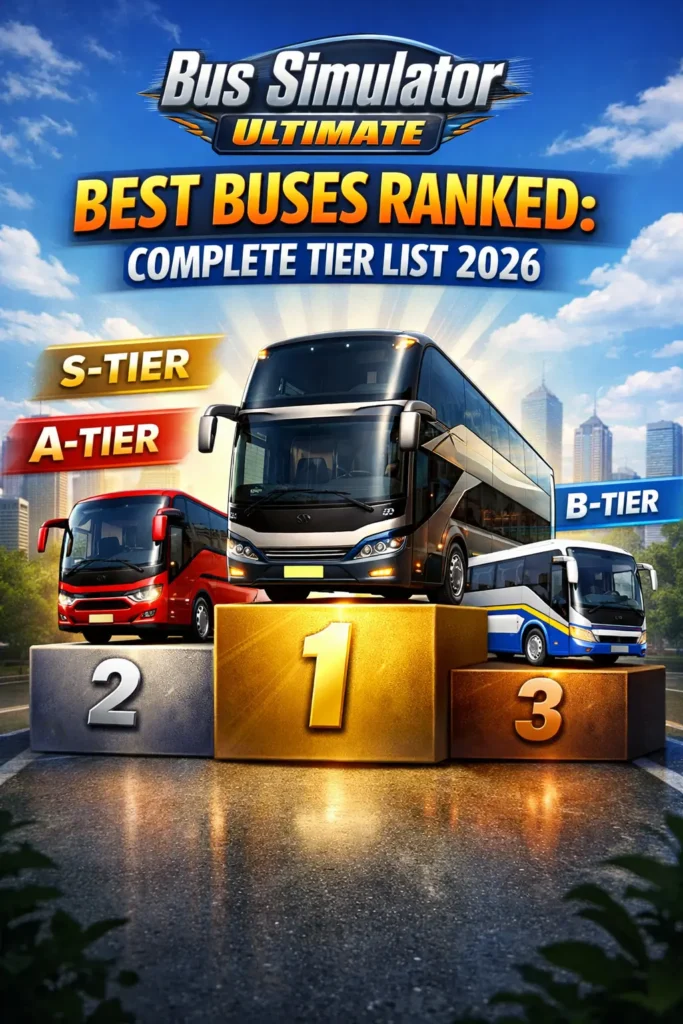
How Buses Are Ranked: The Tier System Explained
This ranking uses four tiers based on overall value, not just raw specs.
S-Tier (Elite): the best buses for making money. Worth the investment for both beginners and experienced players.
A-Tier (Excellent): great buses with specific strengths. Slightly less versatile than S-tier but still strong choices.
B-Tier (Good): solid buses that get the job done, useful for specific routes or situations.
C-Tier (Budget or Niche): starter buses or highly specialized models, worth using early game before upgrading.
Buses are evaluated on fuel efficiency, passenger capacity, purchase price, speed, and passenger comfort. A bus that costs more but earns meaningfully more per route ranks higher than a cheap bus that barely turns a profit.
S-Tier Buses: The Best of the Best
These buses deliver the strongest returns. If you can afford them, they are worth buying early.
1. Setra S 531 DT
Price: High. Capacity: 70+ seats. Fuel efficiency: 0.22 L/km. Top speed: 120 km/h. Best for: long distance routes, maximum profit.
The Setra S 531 DT dominates long routes. The double-decker configuration means more passengers per trip, and its fuel efficiency keeps costs manageable even on routes over 4,000 km. Passengers tend to rate it highly thanks to its comfort features, which helps company reputation as well as tips.
Why S-Tier: one of the strongest profit-per-kilometer ratios in the game. The high capacity combined with premium comfort justifies charging higher fares, and it tends to pay back its cost within a reasonable number of routes for anyone running long haul lines regularly.
2. Mercedes-Benz Travego 16 SHD
Price: High. Capacity: 60 seats. Fuel efficiency: 0.24 L/km. Top speed: 120 km/h. Best for: any route, most versatile bus.
If you can only own one premium bus, the Travego is a reasonable choice. It handles everything from short city hops to long transcontinental journeys well. The aerodynamic design helps fuel economy on highway routes.
Why S-Tier: no real weak points. It performs well across every category without sacrificing much anywhere, which makes it a good fit for players who want one premium bus that handles most situations.
3. Scania Touring HD
Price: Medium-High. Capacity: 55 seats. Fuel efficiency: 0.18 L/km, the best in the game. Top speed: 115 km/h. Best for: ultra long routes, fuel cost minimization.
The Scania Touring has the lowest fuel consumption of any bus in the game. On routes over 3,000 km, that efficiency saves a meaningful amount of coins compared to less efficient models, and the slightly lower passenger capacity is offset by those fuel savings.
Why S-Tier: its efficiency keeps it profitable even on routes where other buses barely break even, making it valuable for players focused on maximizing margins over the long run.
A-Tier Buses: Excellent Performers
These buses excel in specific areas without being quite as versatile as S-tier.
4. Marcopolo Paradiso G7
Price: Medium. Capacity: 48 seats. Fuel efficiency: 0.28 L/km. Top speed: 130 km/h, the fastest bus in the game. Best for: time critical routes, express services.
When speed matters more than fuel economy, the Marcopolo G7 stands out. Its top speed lets it complete routes noticeably faster than other buses, fitting more trips into a session, and its compact size makes city navigation easier than larger double-deckers.
Why A-Tier: a strong speed-to-price ratio. Lower capacity and higher fuel costs keep it out of S-tier, but the time savings are real, especially on shorter routes under 1,000 km where fuel efficiency matters less.
5. Temsa Maraton
Price: Medium. Capacity: 52 seats. Fuel efficiency: 0.25 L/km. Top speed: 118 km/h. Best for: passenger satisfaction, reputation building.
The Temsa Maraton tends to get strong passenger reviews among mid-tier buses, thanks to spacious seating and a smooth ride. It suits players focused on building company reputation and needing consistently high ratings to unlock better routes.
Why A-Tier: passenger satisfaction directly affects earnings and route unlocks, and the Maraton delivers a premium feel at a mid-range price, even if it is not quite as efficient as the S-tier options.
6. Setra S 517 HD
Price: High. Capacity: 65 seats. Fuel efficiency: 0.26 L/km. Top speed: 118 km/h. Best for: high demand routes, busy terminals.
On routes with a high volume of waiting passengers, the Setra S 517 HD maximizes earnings per trip without going full double-decker. Its high-deck design also provides ample luggage space.
Why A-Tier: excellent for routes with demand above roughly 50 passengers where you do not need the full capacity of the S 531 DT, with fuel efficiency solid enough to stay profitable on medium length routes.
7. Volvo 9800
Price: Medium. Capacity: 54 seats. Fuel efficiency: 0.27 L/km. Top speed: 115 km/h. Best for: all weather driving, beginner friendly.
The Volvo 9800 is known for forgiving handling and a stable ride even in difficult conditions, which makes it a common recommendation for players still learning the game’s controls.
Why A-Tier: strong all-weather performance and easy handling. It is not the most efficient or fastest option, but its reliability makes it a solid second or third bus after mastering the basics with a starter model.
B-Tier Buses: Solid Choices
8. Mercedes-Benz Tourismo 16 RHD
Price: Medium. Capacity: 50 seats. Fuel efficiency: 0.29 L/km. Top speed: 115 km/h. Best for: first premium upgrade from starter buses.
A reasonable pick after outgrowing a starter bus but before affording an S-tier model. Fuel efficiency is not its strength, but passenger comfort features help maintain decent ratings.
Why B-Tier: a good stepping stone rather than a long-term bus, still profitable on most routes and a clear step up from starter options.
9. MAN Lion’s Coach
Price: Medium. Capacity: 56 seats. Fuel efficiency: 0.26 L/km. Top speed: 112 km/h. Best for: routes over 2,500 km, endurance trips.
Comfortable seating helps reduce passenger complaints on long routes that would otherwise wear on satisfaction over many hours.
Why B-Tier: too specialized for general use. If your routes skew heavily long haul this bus may rank higher for your fleet specifically, but the slower top speed hurts it on shorter routes where time matters more.
10. Neoplan Skyliner
Price: High. Capacity: 68 seats. Fuel efficiency: 0.30 L/km. Top speed: 118 km/h. Best for: high capacity needs on a tighter budget.
Offers double-decker level capacity at a somewhat lower price than the Setra S 531 DT, at the cost of higher fuel consumption.
Why B-Tier: good capacity but comparatively inefficient. The Setra costs more upfront but tends to save money over a long enough run. Worth buying only if you need capacity now and plan to upgrade later.
11. Temsa Safir Plus
Price: Low-Medium. Capacity: 42 seats. Fuel efficiency: 0.27 L/km. Top speed: 108 km/h. Best for: short city routes under 500 km.
Its smaller size and tight turning radius make it easier to navigate busy city terminals, which suits players running many short trips per session.
Why B-Tier: excellent for short routes, unremarkable for anything longer. A fine, affordable choice for players prioritizing high trip frequency over long distance runs.
12. Setra S 515 HD
Price: Medium. Capacity: 52 seats. Fuel efficiency: 0.28 L/km. Top speed: 115 km/h. Best for: a balanced mid-range option.
It does not excel at anything in particular but does not fail at anything either, making it a dependable if unexciting choice.
Why B-Tier: a safe pick when you are unsure what you need, useful for experimenting with different route types before committing to a more specialized bus.
C-Tier Buses: Budget and Starter Options
13. Mercedes-Benz O403
Price: Low. Capacity: 45 seats. Fuel efficiency: 0.32 L/km. Top speed: 105 km/h. Best for: first bus upgrade, learning the game.
Commonly bought as a second bus, noticeably better than a starter model but still affordable, with forgiving controls that suit practicing on real routes without risking an expensive vehicle.
Why C-Tier: you will likely outgrow it quickly. Its poor fuel efficiency means it barely turns a profit on long routes, so it works best on short and medium routes until you can afford something better.
14. Irizar i8
Price: Medium-Low. Capacity: 46 seats. Fuel efficiency: 0.31 L/km. Top speed: 110 km/h. Best for: players who specifically want this model.
It is not a bad bus, just generally outclassed by similarly priced alternatives on measurable stats.
Why C-Tier: beaten by competitors in most categories that matter for profit. Worth choosing mainly if you prefer its look or interior customization options over pure stats.
15. Yuton ZK6128H
Price: Very Low. Capacity: 38 seats. Fuel efficiency: 0.35 L/km. Top speed: 100 km/h. Best for: absolute beginners, first several routes.
This is typically the starting bus. It gets you from zero to your first upgrade, but its poor fuel consumption and low capacity limit earnings.
Why C-Tier: it exists to be replaced. Focus on completing routes quickly to build capital toward a B-tier bus as soon as reasonably possible.
Best Buses by Category
Best for beginners: the Volvo 9800. Forgiving handling means early mistakes cost less, and new players tend to earn better ratings while learning with it. Consider it as your second bus once you have saved a reasonable amount from your starter.
Best for money making: the Setra S 531 DT. The highest profit-per-route among the buses covered here, especially paired with long haul routes. See the best routes guide for which corridors pair best with it.
Best for long distance routes: the Scania Touring HD. Its fuel savings on the longest routes make it hard to beat, and it pairs well with AI drivers for passive income while you drive shorter routes yourself. The drivers guide covers assignment strategy in depth.
Best for short city routes: the Temsa Safir Plus. Its compact size and turning radius suit city terminals well when you are running many short trips per session.
Best for speed runs: the Marcopolo Paradiso G7. Its top speed is useful in multiplayer sessions or daily challenges where completing routes quickly matters more than fuel efficiency.
Best value for money: the Mercedes-Benz Travego 16 SHD. It is not cheap, but its versatility means you rarely have the wrong bus for a route, which tends to pay back its cost faster than other premium options.
Common Bus Buying Mistakes
Buying based on looks instead of stats: a striking double-decker can drain fuel costs quickly on the wrong routes. Always check fuel efficiency before buying, since a good-looking bus that loses money is still a losing bus.
Assuming every bus has the same passenger comfort features: some buses include amenities like onboard toilets that others do not, and missing an expected amenity can generate passenger complaints. Check a bus’s feature list before assigning it to a route where comfort expectations run high.
Buying expensive buses too early: avoid buying a premium bus like the Setra S 531 DT without a financial buffer for fuel, repairs, and terminal costs. A reasonable rule is having roughly double the bus price saved before buying, so a 200,000-coin bus should wait until you have 400,000 in reserve.
Ignoring fuel efficiency: a bus at 0.35 L/km costs close to twice as much to run as one at 0.18 L/km. Over many routes that gap adds up to a meaningful amount of lost coins, so always compare consumption before purchasing.
Not matching buses to routes: running a 70-seat double-decker on a route with 30 passengers wastes fuel on empty capacity, while running a 42-seat bus on a route with 60 waiting passengers leaves money on the table. Check expected passenger count before selecting your bus.
Complete Bus Comparison Table
| Bus Model | Tier | Capacity | Fuel (L/km) | Speed | Best Use |
|---|---|---|---|---|---|
| Setra S 531 DT | S | 70+ | 0.22 | 120 | Long routes, max profit |
| Mercedes Travego | S | 60 | 0.24 | 120 | All routes, most versatile |
| Scania Touring HD | S | 55 | 0.18 | 115 | Ultra-long routes, fuel savings |
| Marcopolo G7 | A | 48 | 0.28 | 130 | Speed runs, multiplayer |
| Temsa Maraton | A | 52 | 0.25 | 118 | Passenger satisfaction |
| Setra S 517 HD | A | 65 | 0.26 | 118 | High-demand routes |
| Volvo 9800 | A | 54 | 0.27 | 115 | Beginners, all-weather |
| Mercedes Tourismo | B | 50 | 0.29 | 115 | First premium upgrade |
| MAN Lion’s Coach | B | 56 | 0.26 | 112 | Endurance routes |
| Temsa Safir Plus | B | 42 | 0.27 | 108 | Short city routes |
| Neoplan Skyliner | B | 68 | 0.30 | 118 | Capacity on a budget |
| Mercedes O403 | C | 45 | 0.32 | 105 | Starter upgrade |
How to Unlock Buses
Earn coins through routes: completing routes successfully builds the capital most buses require, often alongside a minimum company level.
Company level progression: some premium buses require a certain company reputation level, so keeping passenger ratings high helps you level up faster.
Special events: Zuuks Games periodically runs events offering buses, coins, and gold through missions.
MOD APK: the Bus Simulator Ultimate MOD APK unlocks every bus immediately with unlimited coins, no grinding required.
To unlock premium buses through normal play, focus on a reliable high-profit route with your current bus and build capital while your company reputation grows. See the money guide for the full income strategy.
Frequently Asked Questions
Q: Which bus is best overall in Bus Simulator Ultimate?
The Mercedes-Benz Travego 16 SHD is a strong all-around pick. It performs well across route types, offers solid passenger comfort, and tends to recover its cost faster than most premium buses.
Q: What is the fastest bus in Bus Simulator Ultimate?
The Marcopolo Paradiso G7 is the fastest bus in the game, reaching up to 130 km/h.
Q: Which bus has the best fuel efficiency?
The Scania Touring HD consumes about 0.18 L/km, the most fuel efficient bus covered here. On routes longer than 3,000 km, that efficiency saves a meaningful amount of coins compared to less efficient buses.
Q: What’s the best bus for beginners?
The Volvo 9800 is a common recommendation for beginners due to its forgiving handling. New players tend to make fewer mistakes and earn better ratings while learning routes with it.
Q: Do expensive buses actually make more money?
Generally yes, when used correctly. Buses like the Setra S 531 DT earn significantly more on long routes, but using an expensive bus on a short route wastes its earning potential.
Q: Can I customize buses after buying them?
Yes. Paint, interiors, and performance upgrades can be adjusted in the garage. Cosmetic changes do not affect performance, so functional upgrades are usually worth prioritizing first.
Q: Should I buy used buses from the marketplace?
Used buses cost less upfront but can carry higher maintenance needs. In most cases a new bus works out more profitable over the long term, though a used bus can make sense as a stopgap.
Q: What’s the most profitable route for earning money fast?
Short, high frequency routes tend to be strong early earners, while longer routes pay more per trip but take significantly more time to complete. See the best routes guide for specific recommendations.
Q: Do MOD APK buses perform differently?
No. Buses perform the same in the official version and the MOD APK. The MOD only unlocks content instantly rather than changing how any bus performs.
Q: How many buses should I own?
Starting with 2 to 3 buses and expanding gradually to a larger fleet as income supports it is a reasonable approach. Owning too many buses too early increases maintenance costs without the income to support them.
Q: Can I sell buses I no longer use?
Yes. Selling unused buses recovers a portion of their value and reduces unnecessary parking and maintenance costs.
Final Recommendations: Your Bus Buying Strategy
A reasonable progression path looks roughly like this.
Early phase: keep your free starter bus, complete a batch of short routes to build early capital, then buy a Volvo 9800 as your first real upgrade and use it across most routes while learning the game’s mechanics.
Growth phase: once capital allows, consider selling the starter bus and adding a Temsa Safir Plus for short routes or a Marcopolo G7 if speed matters more for your playstyle, while building toward a premium bus purchase.
Premium phase: once you can comfortably afford it, add a Mercedes-Benz Travego or Setra S 531 DT and use it on your most profitable routes, keeping a budget bus around for AI driver assignment.
Optimization phase: aim for a fleet of several buses covering different route types, with your best buses reserved for routes you drive yourself and more budget-friendly options handling AI driver assignments.
Or skip the grind entirely with the Bus Simulator Ultimate MOD APK and unlock every bus from day one with unlimited coins.
Bottom Line
The best bus in Bus Simulator Ultimate depends on your needs. For pure profit, the Setra S 531 DT is hard to beat. For versatility, the Mercedes-Benz Travego handles nearly everything well. For beginners, the Volvo 9800 makes learning easier. The key is matching your bus to your routes and playstyle rather than chasing the flashiest option in the showroom.
Check the controls guide to master driving these buses, and see the PC installation guide if you want to play on a bigger screen.