
Bus Simulator Ultimate
Bus Upgrades Guide
Worth It or Waste of Money?
You just spent a chunk of your hard-earned in-game cash upgrading a starter bus, and your route profits barely moved. Now you are sitting there wondering if you completely wasted that money when you could have been saving toward something that actually grows your company. That exact frustration is one of the most common complaints across the entire Bus Simulator Ultimate community.
The upgrade system in this game is genuinely powerful when you use it correctly, and genuinely punishing when you do not. Dumping coins into the wrong bus at the wrong stage of your career is one of the slowest ways to kill your company growth. Knowing which upgrades deliver real returns versus which ones just look impressive on the stat screen makes the difference between a fleet that compounds income and one that stalls out at the same level for weeks.
This Bus Simulator Ultimate bus upgrades guide breaks down every upgrade type, gives you a clear decision framework for when to upgrade versus when to buy new, and maps out the best upgrade path for every stage of your career. Every recommendation is built around actual profit impact, not just stat numbers.
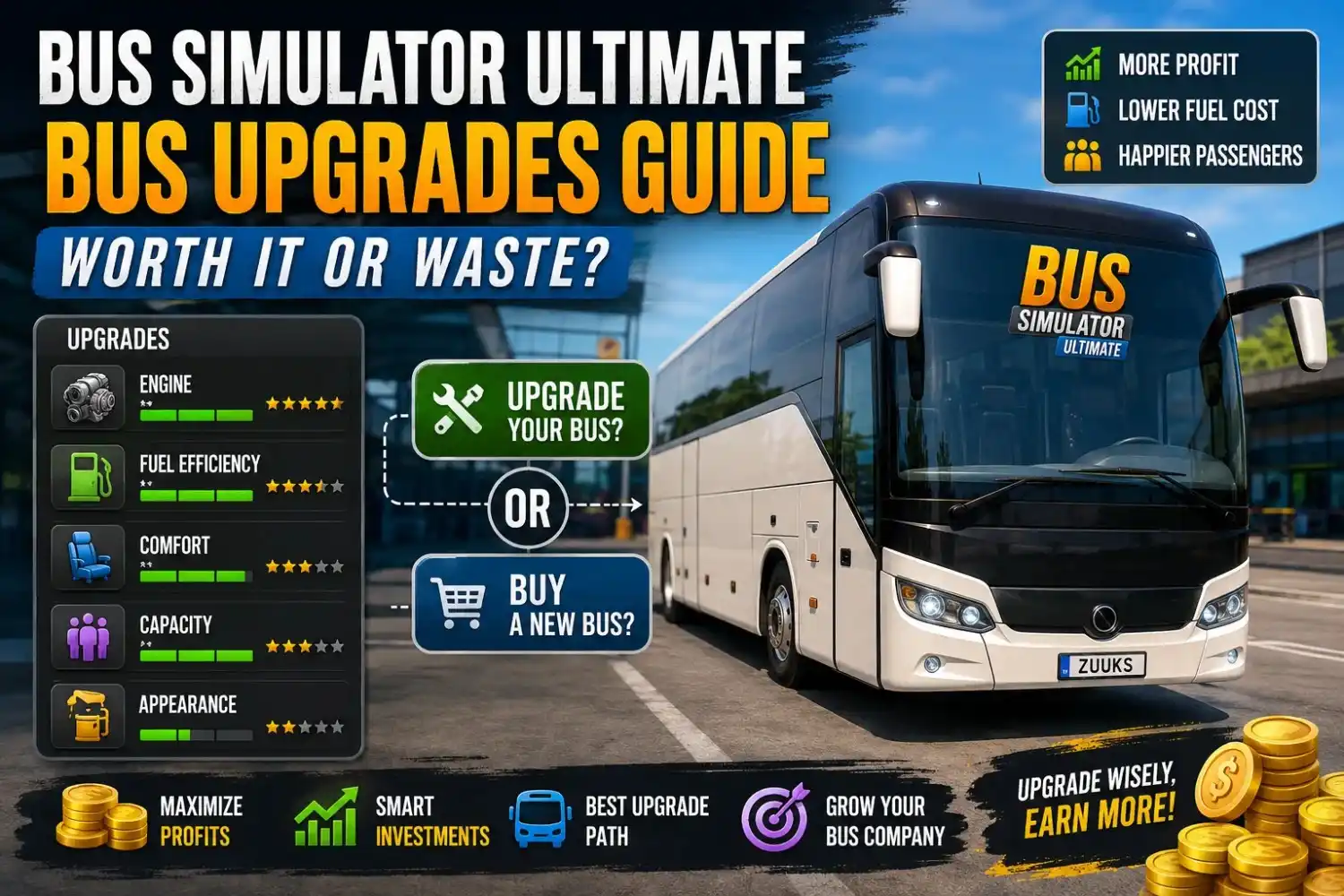
What Bus Upgrades Actually Do in Bus Simulator Ultimate
Bus upgrades in Bus Simulator Ultimate directly modify the performance stats of an individual vehicle in your fleet. Each upgrade type targets a specific mechanical or comfort variable that affects one or more aspects of your route profitability. The key thing most players miss is that upgrades do not increase ticket prices. They improve the efficiency and quality multipliers that determine how much of the potential revenue from a route you actually capture.
Zuuks Games built the upgrade system to simulate realistic vehicle improvement decisions that a real bus company operator would face. A newer engine on an older frame gives you better speed and lower fuel burn without replacing the entire vehicle. A comfort upgrade makes passengers more willing to pay full fare and tip generously. These are not arbitrary stat boosts, they are mechanics with direct income consequences that show up on your post-trip summary every single run.
Understanding each upgrade category before spending a single coin is the foundation of a smart fleet strategy. Check our bus customization guide for the full breakdown of visual versus performance modifications and how to avoid confusing the two when budgeting upgrades.
Upgrade Your Bus or Buy a New One?
This is the question every Bus Simulator Ultimate player hits at some point, and it has no single universal answer. The right call depends entirely on three things: how much your current bus earns per day, how far along your career progression is, and what the upgrade would actually cost versus what a replacement vehicle would cost. Getting this calculation wrong in either direction wastes significant money.
Upgrading an underperforming bus makes sense when the upgrade cost is low relative to the income improvement and when the bus model itself has enough long-term ceiling to justify investment. Buying a new bus makes sense when you have hit the upgrade ceiling on your current vehicle, when a newer model would earn significantly more on the same routes, or when you are entering a new region that demands a better vehicle class entirely.
The decision tree below gives you a clear framework to follow so you never have to guess which path is right for your specific situation at any point in your career.
Best Bus Upgrades for Beginners
The biggest early-game mistake players make is copying the upgrade choices they see discussed for mid or late-game fleets. What works on a Mercedes-Benz Travego at 50 hours in does not apply to a Temsa Safir Plus at 5 hours in. Your first upgrade coins need to do one specific job: reduce operating costs and increase the consistency of your satisfaction scores so your net income climbs fast enough to fund proper fleet expansion.
Engine upgrades feel exciting early on but they deliver their biggest return when a bus is already on longer or faster routes. In the beginner phase where your routes are shorter and lower speed, comfort and fuel efficiency upgrades move the profit needle faster because they work on every single route regardless of distance or speed characteristics.
- 1Passenger Comfort Directly boosts your satisfaction baseline and tip income on every trip from day one. Cheapest upgrade with immediate visible income impact on post-trip summaries.
- 2Fuel Efficiency Reduces the operating cost eating into your early-game margins. Every coin saved on fuel is a coin available for fleet expansion sooner.
- 3Engine (Tier 1 only) One level of engine upgrade improves your acceleration and reduces trip time slightly. Do not go beyond tier 1 on a starter bus as the cost-to-return ratio drops sharply past that point.
Best Upgrades for Mid-Game Players
By mid-game you have a working fleet, consistent route income, and a realistic budget to make meaningful upgrade investments. This is where engine upgrades become the highest-priority spend because your buses are now running longer routes where the speed and fuel efficiency improvements from a quality engine upgrade directly translate to more completed routes per session and lower per-trip costs across a larger fleet.
Capacity expansion also starts making economic sense at this stage because your higher-traffic mid-game routes are consistently hitting passenger demand ceilings. A bus that could carry more passengers per trip on a busy urban line pays back a capacity upgrade quickly through accumulated ticket revenue across repeated runs.
- 1Engine (Full Upgrade) Full engine upgrade on your primary earning buses delivers the highest single ROI of any upgrade at this stage. Speed, fuel burn, and route efficiency all improve simultaneously.
- 2Capacity Expansion For buses on consistently full routes. More passengers on the same trip means more ticket revenue with zero additional operating cost per run.
- 3Fleet Expansion Adding a second or third bus to your roster at this stage compounds income faster than further upgrading a single vehicle. Assign your AI drivers to new buses on proven profitable routes.
Best Upgrades for Advanced Fleets
Late-game upgrade strategy is fundamentally different from earlier stages because your income is already strong enough that individual upgrade ROI matters less than strategic fleet composition. At this point you are not looking for incremental improvements. You are making wholesale decisions about which vehicle classes belong in which regions and which routes justify premium bus investment.
Vehicles like the Setra S 531 DT, Volvo 9800, and Scania Touring HD represent the tier where a new bus purchase outperforms any amount of upgrading you could do to a mid-tier vehicle. The performance gap between a fully upgraded mid-tier bus and a premium bus in its default configuration is significant enough that the math strongly favors buying new over upgrading old at this stage. For a full ranking of which premium models deliver the best return, check our best buses in Bus Simulator Ultimate guide.
- 1Premium Bus Purchase Stop upgrading mid-tier vehicles. Buy the best bus available for each region and route type. The income difference justifies the cost within a short number of completed routes.
- 2Driver Team Expansion More AI drivers on premium buses running proven routes is the fastest income compounding mechanism available in late-game BSU. See our full AI drivers guide for assignment strategy.
- 3Route Optimization Across Countries Expand into higher-revenue regions with your premium fleet. Different country routes have different income ceilings and some premium buses are specifically built for certain map regions.
Engine Upgrade vs Passenger Comfort Upgrade: Which Wins?
This is the most debated upgrade choice in the BSU community and the answer changes depending on your current game stage and route type. Both upgrades are high-value when used correctly and both are poor investments when applied at the wrong time. The key is matching the upgrade to the specific income problem you are trying to solve on that particular bus.
If your post-trip summaries show low satisfaction scores and minimal tip income, comfort upgrades solve your problem directly and immediately. If your summaries show strong satisfaction but high fuel costs or slow route completion dragging down profitability, engine upgrades are the fix. Reading your actual trip data before deciding is more reliable than following a generic priority list.
| Factor | Engine Upgrade | Comfort Upgrade |
|---|---|---|
| Primary benefit | Speed + fuel efficiency | Satisfaction + tips |
| Best for beginners | Tier 1 only | Yes, first priority |
| Best for mid-game | Full upgrade recommended | If satisfaction is low |
| Impact on long routes | Very high | Medium |
| Impact on short city routes | Medium | High |
| Affects AI driver performance | Yes, directly | Yes, raises baseline |
| Payback speed | Fast on long routes | Fast on any route |
Upgrade Costs vs Profit Gains: Full ROI Breakdown
Spending money on upgrades without understanding the return timeline is how players end up stagnating in the early and mid-game phases. The table below maps each upgrade type to its approximate cost tier, the profit impact you can realistically expect, and the stage of your career where it delivers its best return. Use this as your reference before committing coins to any upgrade decision.
| Upgrade Type | Cost Level | Profit Impact | Best Stage | Verdict |
|---|---|---|---|---|
| Comfort (full) | Low | High | Beginner | Buy First |
| Fuel Efficiency | Low | High | Beginner | Buy Early |
| Engine (Tier 1) | Low | Medium | Beginner | Worth It |
| Engine (Full) | Medium | Very High | Mid-Game | Best ROI |
| Capacity Expansion | Medium | Medium to High | Mid-Game | Conditional |
| Maintenance Package | Medium | Medium | Any Stage | Situational |
| Cosmetic Upgrades | Medium | None | Late Game Only | Skip |
| New Premium Bus | Very High | Very High | Late Game | Best Investment |
Worst Upgrades That Waste Money in BSU
Knowing what not to spend on is just as valuable as knowing what to buy. Players who read upgrade guides get the priority list right but still lose money because they fall into one of these four recurring spending traps. All four are easy to avoid once you know what to look for.
Spending full upgrade budget on a starter bus when you are most of the way to affording a mid-tier replacement is a classic trap. The starter bus hits an upgrade ceiling that still leaves it below a fresh mid-tier vehicle. Save those coins and buy the better bus instead of polishing a vehicle with limited ceiling.
Liveries and wraps deliver zero income return. They look great but they come directly out of the budget that should be funding your next engine upgrade or fleet expansion. Cosmetics belong in late-game when income is stable and you have surplus coins beyond what your growth strategy requires.
A capacity upgrade only pays back when your existing passenger load is consistently hitting the current limit. Buying extra seats on a half-full bus generates zero additional revenue and burns money that would have returned more as a fuel or comfort upgrade on the same vehicle.
Engine upgrades deliver their biggest return on long-distance highway routes where speed differences compound across kilometers. Spending full engine upgrade budget on a city loop bus where top speed is irrelevant because of stop density means you are paying premium price for a benefit that barely activates on that route type.
Best Buses Worth Upgrading Long Term
Not every bus in your fleet deserves upgrade investment. The decision to upgrade a specific vehicle should be based on how long it will remain in active service, what routes it runs, and whether its base stats give it enough ceiling to return on the upgrade cost before you rotate it out of your fleet. Some buses are worth maximizing fully while others should be retired the moment you can afford better.
| Bus Model | Upgrade Worth? | Best Upgrade | Route Type |
|---|---|---|---|
| Temsa Safir Plus | Tier 1 Only | Comfort + Fuel | Short city routes |
| Marcopolo Paradiso G7 | Yes | Full Engine + Comfort | Long-distance highway |
| Volvo 9800 | Fully Worth It | Full Engine + Capacity | High-traffic corridors |
| Scania Touring HD | Fully Worth It | Full Engine + Fuel | Long international routes |
| Mercedes-Benz Travego | Yes, mid-late game | Engine + Comfort | Premium cross-country |
| Setra S 531 DT | Full Investment | Capacity + Engine | Double-deck premium routes |
When you are deciding which routes to pair with your upgraded buses, check our best routes guide for a breakdown of which corridors deliver the strongest revenue per kilometer across all available map regions. And to connect upgrade strategy directly to income growth, our make money fast guide covers the complete profit acceleration strategy from fleet management through to route optimization.
When to Stop Upgrading and Replace Your Bus
Every bus in Bus Simulator Ultimate has a practical upgrade ceiling, the point where further investment returns diminishing value compared to what the same money would buy in fleet expansion or a better vehicle purchase. Recognizing this ceiling before you hit it is what separates players who grow their companies efficiently from those who pour endless coins into vehicles that will never perform like a premium model regardless of how much they invest.
Three clear signals tell you it is time to replace rather than upgrade. First, you have completed all high-value upgrades on the bus and its daily earnings have plateaued with no further improvement path available. Second, a newer bus model at a similar or only moderately higher price would deliver substantially better performance on the same route without any upgrades at all. Third, your best routes have grown beyond what your current vehicle class can service effectively even at maximum upgrade level.
Frequently Asked Questions
It depends entirely on your daily earnings from that bus and how close you are to the upgrade ceiling. If the bus earns under 10,000 coins per day and has upgrade headroom remaining, invest in upgrades first. If it earns over 30,000 coins per day and is already well-upgraded, buy a new bus and assign this one to a secondary route with an AI driver.
The full engine upgrade on a mid to late-game bus gives the highest combined return of any single upgrade. It improves speed, fuel consumption, route completion time, and AI driver performance simultaneously. On long-distance routes specifically, the fuel savings alone tend to recover the upgrade cost faster than any other single investment.
Yes, directly. A better engine completes routes faster, which means more routes completed per session. It also burns less fuel per kilometer, which reduces your largest operating cost on every single trip. On long routes these two effects compound into a noticeable income improvement that shows up clearly in your weekly earnings summary.
Generally yes, at the right stage. Vehicles like the Setra S 531 DT and Volvo 9800 tend to earn more than upgraded starter or mid-tier buses on the same routes because of their higher passenger capacity, better base fuel efficiency, and stronger passenger satisfaction ratings right out of the showroom.
Yes. AI drivers assigned to fully upgraded buses earn more per route than AI drivers on unupgraded vehicles because the engine and comfort improvements work regardless of who is driving. However, AI driving style still generates more complaints than manual driving, so your upgraded AI-driven buses will not reach the same satisfaction scores as manually driven ones on identical routes.
A solid rule is to save until you can purchase the new bus and still retain roughly 30 percent of that amount as operating reserve. Buying a new bus and depleting your cash reserves completely leaves you unable to cover maintenance costs and service fees across your existing fleet while the new vehicle builds up its income stream.
Comfort and fuel efficiency upgrades deliver the best return in the early game because they work on every trip regardless of route length or speed. They directly increase tip income and reduce your largest operating cost simultaneously. Hold off on full engine upgrades until mid-game when your routes are long enough for speed and efficiency improvements to make a meaningful difference in completion times.
Only cosmetically, and only in late-game when income is consistently strong. Liveries and visual upgrades have zero impact on performance, satisfaction scores, fuel consumption, or route revenue. They are purely aesthetic. Spending on them during your growth phase directly delays fleet expansion and should be avoided until your income compounds well beyond your operating costs.
Final Tips for Your Complete Bus Upgrade Strategy in 2026
Bus upgrades in Bus Simulator Ultimate are one of the highest-leverage systems in the game when you approach them with a clear framework. Every coin you spend on the right upgrade at the right stage compounds into faster fleet growth, lower operating costs, and stronger satisfaction scores across your entire company operation.
The players who grow their companies fastest are not the ones spending the most on upgrades. They are the ones spending most efficiently. Use the decision framework, respect the stage-based priority order, and never let cosmetics eat budget that belongs in engine or comfort upgrades during your growth phase.
- Always upgrade comfort and fuel efficiency first in the beginner stage. These two upgrades work immediately on every route and give you the fastest visible income improvement from any upgrade investment in your early career.
- Use the upgrade vs buy decision framework before committing to any significant upgrade spend. If the bus earns over 30,000 coins per day and has strong upgrade coverage already, buy a new bus rather than continuing to invest in the same vehicle.
- Read your post-trip summary before upgrading. Low satisfaction scores mean comfort upgrades solve the problem. High fuel costs mean engine or fuel efficiency upgrades are the right call. Let your actual data drive the decision.
- Never fully upgrade a bus you plan to replace within 20 sessions. Put those coins toward the replacement purchase instead and let the better vehicle earn its own upgrade investment after it is generating income in your fleet.
- Match your best upgraded buses to your highest-traffic routes and assign AI drivers to secondary lines with leaner vehicles. This pairing maximizes the return on your upgrade investments while keeping AI driver inefficiency away from your premium earnings lines.
- Expand into new countries only after your existing fleet is properly upgraded and generating consistent income. Rushing into new regions with underpowered vehicles stretches your operating budget before your income base can support it.