
⏱ Read Time: 6 Min 📱 Android / iOS / PC 🎮 All Versions ✅ Updated: June 2026
Your trips are finishing with 3 stars, your revenue is flat, and you have no idea what you are actually doing wrong. This is one of the most common frustration points in Bus Simulator Ultimate, and it quietly kills company growth for players who never figure out the real cause. Passenger satisfaction is not just a vanity score, it directly controls your income on every route you run.
A full 5-star trip pays out noticeably more than a 3-star one because passenger tips scale with your rating. Multiply that difference across many routes a day with a full fleet of AI drivers, and the gap between players who understand this system and those who do not compounds into a real earnings difference over a full career playthrough.
This passenger satisfaction guide breaks down exactly how the rating system works, which driving behaviors damage your score, what complaints passengers file and why, and the actions that lock in a 5-star rating before you reach the final stop.
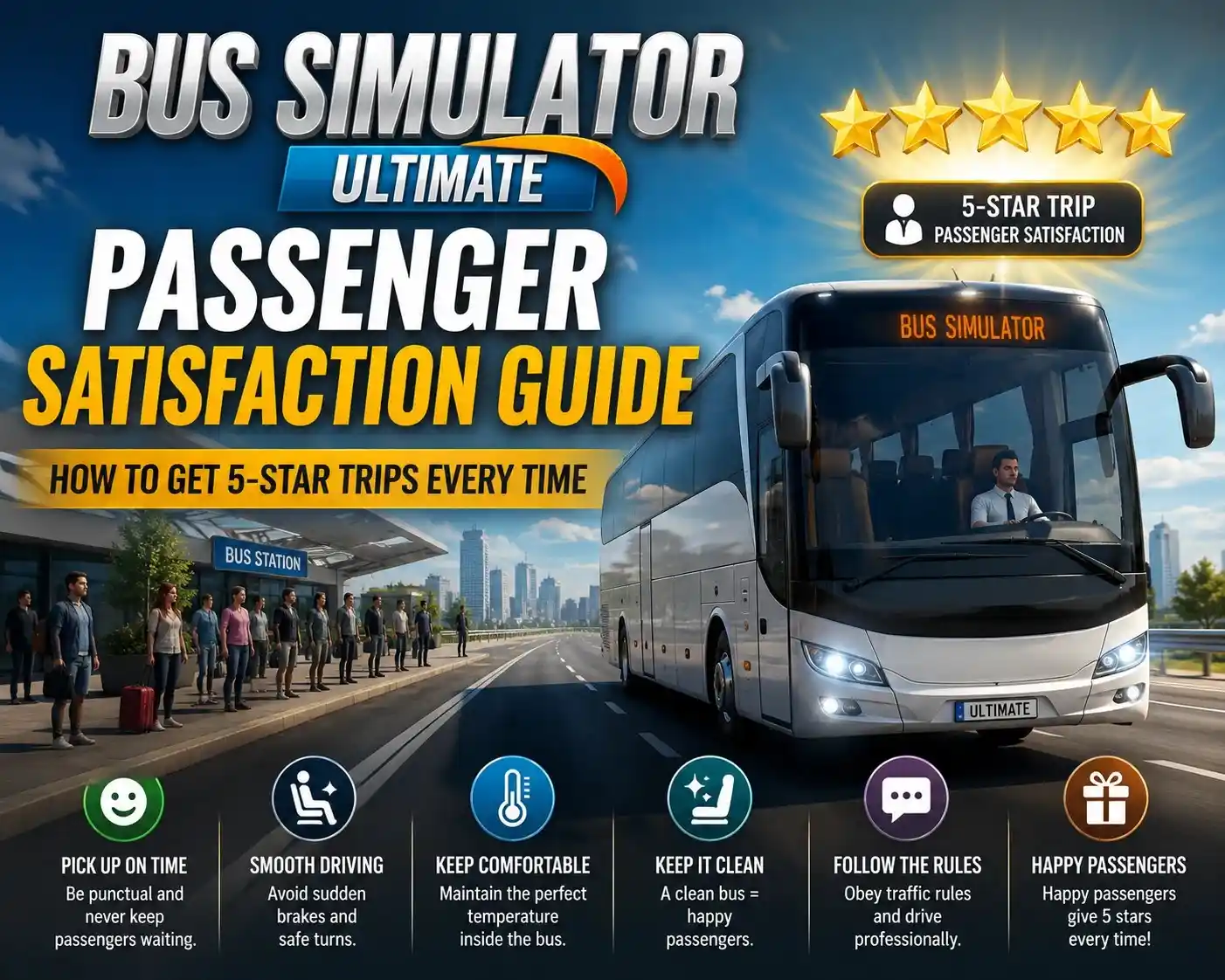
Passenger satisfaction in Bus Simulator Ultimate is a per-trip star rating from 1 to 5 determined by your driving smoothness, arrival timing, stop accuracy, and route completion rate. Maintaining consistent 5-star ratings increases tip income and company reputation, directly boosting total earnings across your fleet.
⬇ Download Bus Simulator Ultimate Latest Version
How the Passenger Satisfaction Rating System Works
Every route you complete generates a passenger satisfaction score calculated live throughout the trip. The game tracks driver behavior from the moment you open the door at your first stop to the second your last passenger exits at the final terminal. Nothing is averaged at the end, bad moments during the trip reduce the score in real time and that damage sticks.
The score displays as a star rating from 1 to 5 on your post-trip summary screen. Most players treat this number as a general performance grade, but it is actually a direct income multiplier. Passengers tip based on their satisfaction level, and those tips add up to a meaningful share of your total route revenue when you consistently hit high scores across multiple vehicles.
Your company reputation score, which affects how quickly you unlock new routes and regions, also draws heavily from your rolling average passenger satisfaction across recent trips. A driver fleet full of AI vehicles running mediocre 3-star trips will hold your company reputation below the threshold for premium route unlocks longer than necessary. Understanding this system is one of the fastest levers you have for accelerating progression. See how route selection ties into earnings growth in the career mode guide.
What Each Star Rating Means
5 Stars: Perfect or near-perfect trip. Smooth driving, accurate stops, on time arrival, zero complaints. Maximum tip payout.
4 Stars: Good trip with minor issues, such as a slightly late arrival or a mildly sharp brake. Reduced but still solid tip income.
3 Stars: Average trip. Multiple driving complaints logged during the route. Tip income drops noticeably and reputation gain is minimal.
2 Stars: Poor trip. Aggressive driving, missed stops, or significant delays caused multiple passenger complaints. Near-zero tip income.
1 Star: A trip with collisions, multiple missed stops, or extreme driving behavior. Actively damages company reputation.
Your post-trip screen shows the star rating but not the individual deduction breakdown. Pay attention to the complaint pop-ups that appear during the trip in real time, since those are your direct feedback on what is costing you stars as it happens.
Passenger Complaints: What Triggers Them and Why
Passenger complaints are the in-trip notification system that tells you your satisfaction score is dropping right now. Each complaint icon that floats up from the passenger area represents a specific deduction applied to your current trip rating. You can collect multiple complaints on a single trip, and each one stacks against your final star score.
The complaint system simulates the perspective of a real paying passenger. Think about what would actually annoy you as a rider: sudden jolts, late arrivals, a driver who blows past your stop, or a bus that was never serviced. All of those translate directly into complaint triggers in the game.
Hard braking: sudden deceleration from speed causes passengers to lurch forward and file an immediate complaint.
Excessive speed: driving significantly above the posted limit triggers complaints and risks traffic violation penalties stacking on top.
Missed stop: driving past a scheduled stop without opening the doors causes every waiting passenger to file a complaint at once.
Late arrival: arriving at stops or the terminal well outside your scheduled window gets judged harshly on punctuality.
Traffic collision: any contact with another vehicle or roadside object registers as a safety incident and triggers immediate complaints.
Poor bus condition: running a bus with low maintenance status causes passengers to notice vehicle quality and file complaints before you even drive badly.
Aggressive cornering: taking turns at high speed forces passengers to grab handrails or stumble, and each sharp corner can trigger a separate complaint.
Door timing issues: closing doors while passengers are still boarding, or opening them at the wrong position on the stop zone, creates complaints about rushed or inaccurate service.
Missed stops are the single most damaging complaint category. One missed stop can generate complaints from every passenger assigned to that stop at once, collapsing a 5-star trip to a 2-star result in a single moment. Always know where your next stop is before you pass the halfway point to it.
Driving Mistakes That Kill Your Star Rating
Most players who consistently score 3 stars or below are making the same three or four mistakes on every trip without realizing it. The issues are rarely dramatic, you are not crashing into buildings or missing every stop. The real problems are small habitual driving behaviors that each trigger a minor deduction, and when those stack across a full route the total damage adds up to a rating drop you never saw coming.
| Driving Mistake | Impact | How Often It Triggers |
|---|---|---|
| Braking hard within 50m of a stop | High | Every stop where you brake late |
| Exceeding speed limit by 20+ km/h | High | Per sustained speeding period |
| Touching another vehicle or object | Critical | Each collision event |
| Missing a scheduled stop entirely | Critical | Per missed stop, per waiting passenger |
| Cornering above 50 km/h | Medium | Each corner taken too fast |
| Late arrival at final terminal | Medium | Once per trip if delayed |
| Bus maintenance below 50% | Medium | Passive penalty throughout the trip |
| Stopping outside the designated zone | Low | Per inaccurate stop placement |
Braking at the last second before every stop is the most common habit that tanks satisfaction scores. Players drive at full speed between stops and only start braking when the stop marker is right under the bus, generating a hard brake complaint at almost every stop. The fix is to start lifting off the throttle well before each stop and let the bus coast down naturally before applying gentle braking near the end. Exact timing is covered in the driving method below.
Accelerating flat out between every stop wastes fuel, increases wear, and forces the hard braking situation at the next stop, generating complaints at both ends of the transition. Accelerate to your cruising speed smoothly and hold it steady instead, so you arrive at the next stop with enough distance to brake gently.
Not watching the mini map for upcoming stops is almost always why a stop gets missed. You drift past the marker, realize it too late, and cannot reverse to serve it, which can destroy a near-perfect trip rating instantly. Keep one eye on the mini map at all times, and begin decelerating as soon as a stop icon appears ahead regardless of your current speed.
Sending poorly maintained buses on routes generates passive satisfaction penalties throughout the entire trip even when your driving is perfect. Players often wonder why they cannot break above 3 stars despite driving smoothly, and this is frequently the silent cause. Check every bus before assigning it to a route and service anything below 70 percent maintenance beforehand.
⬇ Download Latest Version Free
How to Get 5-Star Trips
A 5-star trip is not luck. It is the result of three things happening consistently: smooth driving inputs, accurate stop servicing, and a well maintained bus. When all three are present and no collision or missed stop disrupts the run, the game has no mechanism to reduce your score below 5 stars.
Method 1: Master Your Driving Inputs
Driving technique is the primary controller of passenger satisfaction. Locking in these habits eliminates most complaint triggers on every trip you run from this point forward.
- Set your cruising speed target: on city routes aim for 40 to 55 km/h between stops, and on open highway sections stay between 65 and 80 km/h. These ranges keep you legal and give you natural braking distance.
- Start decelerating early at every stop: once the next stop appears on your mini map within roughly 150 meters, lift off the throttle completely and let the bus slow through engine braking first, applying the service brake lightly only in the final stretch.
- Accelerate out of stops in two phases: ease into throttle from standstill, then move to full throttle for the open road section. This feels natural and avoids hard acceleration complaints.
- Take corners at a controlled speed: slow down before every turn rather than during it, since your speed on corner entry is the variable that matters most.
- Maintain a following gap in traffic: following too closely forces reactive braking whenever traffic slows, while a comfortable gap lets you brake gradually every time.
Method 2: Nail Your Stop Accuracy and Timing
Even perfect driving between stops will not save a 5-star rating if your stop servicing is sloppy. Stop accuracy, door timing, and punctuality are tracked separately from driving behavior and can each cost a star on an otherwise clean run.
- Line up with the stop zone marker: approach the stop straight and center your bus on the marker rather than stopping slightly before or after it.
- Open doors immediately on stopping: a delay of more than a second or two after coming to a full halt registers a brief complaint window.
- Wait for the boarding indicator to clear: closing doors on a boarding passenger triggers a complaint and a minor penalty.
- Keep your schedule in view: if you are running noticeably behind, increase your cruising speed slightly on the next clear stretch to recover time before it compounds into a late arrival penalty.
- Never skip a stop to save time: the satisfaction hit from one missed stop costs more income than the time saved by skipping it.
Method 3: Manage Your Fleet Condition Before Every Departure
Passenger satisfaction begins before you leave the depot. The condition of your bus when it rolls out sets a baseline that your driving either maintains or works against for the rest of the trip.
- Service any bus below 70 percent maintenance before assigning it: a quick check before the route assignment screen prevents passive penalties across the entire run.
- Schedule proactive maintenance between routes: book servicing after a handful of completed routes rather than waiting for the warning indicator to appear.
- Assign your newest buses to your highest traffic routes: peak passenger routes carry more satisfaction weight since more active passengers are rating the trip at once.
- Check fuel level before every departure: running critically low mid-route forces erratic driving as you rush toward a station, so refuel before departing to remove that variable entirely.
Company-wide, AI driven routes tend to score lower than manually driven ones, which pulls down your overall satisfaction average. Periodically taking over an underperforming AI route for a session or two is usually enough to rebuild its reputation. The drivers guide covers assignment strategy in more depth.
5-Star Trip vs 3-Star Trip: What You Are Actually Losing
To make the income impact concrete, here is a comparison of what a 5-star trip delivers versus a 3-star trip across the key metrics, based on a standard mid-length route with a mid-tier bus and a normal passenger load.
| Metric | 5-Star Trip | 3-Star Trip |
|---|---|---|
| Base ticket revenue | Full amount | Full amount |
| Passenger tip income | Maximum payout | Minimal to none |
| Company reputation gain | Strong positive | Minimal |
| Route unlock speed | Faster progression | Slower unlock rate |
| Driver performance rating | Improves over time | Stagnates or declines |
| Long-term earnings impact | Compounds positively | Caps your income ceiling |
Base ticket revenue is identical regardless of your rating, since that part is locked by the route itself. Every income advantage from a 5-star trip comes from the tip layer and the reputation multiplier sitting on top of that base. Across a full session with multiple drivers running simultaneously, that tip difference is a meaningful part of the gap between a company that grows quickly and one that barely breaks even. See the money guide for how satisfaction connects to the broader income strategy.
Frequently Asked Questions
Q: What is the fastest way to improve passenger satisfaction?
Eliminating hard braking at stops tends to have the single biggest impact. Start decelerating well before each stop and let the bus coast down gently. This removes one of the most frequent complaint triggers and often noticeably lifts your average score within the same session.
Q: Does passenger satisfaction affect how much money I earn per route?
Yes, directly. Passenger tips scale with your satisfaction rating, and tips represent a meaningful share of total route income on well populated lines. A 5-star trip earns noticeably more than a 3-star trip on the same route with the same ticket prices, purely through the tip difference.
Q: Do AI drivers affect my company’s overall passenger satisfaction score?
Yes. AI drivers tend to score lower than a skilled human player because their driving style triggers more complaints per route, and your company reputation averages across all drivers.
Q: Can I recover a trip rating after getting a complaint mid-route?
Once a complaint is logged it reduces that trip’s score permanently. You cannot recover lost stars within an active trip, but driving cleanly for the rest of the route limits further damage and keeps you closer to 3 or 4 stars rather than dropping lower.
Q: Why do I keep getting 3 stars even when I think I drove well?
The most common hidden causes are bus maintenance below 70 percent generating a passive penalty, and subtle hard braking complaints at stops you did not notice because you were focused on the road. Check your maintenance level and watch for the small complaint icons that appear mid-trip.
Q: Does route length or difficulty affect how easy it is to get 5 stars?
Longer routes with more stops give you more opportunities to accumulate complaints, making consistent 5-star scores somewhat harder to maintain over a full run. Short to medium routes with 4 to 8 stops are a reasonable training ground for building these habits before taking them into longer runs.
Final Tips to Lock In 5-Star Ratings Consistently
Passenger satisfaction is one of those systems that feels invisible until you understand it, and then obvious once you do. The game gives you real time feedback on every trip through the complaint pop-ups, most players just do not know how to read them or what to change in response.
- Service your bus before it drops below 70 percent. Maintenance condition is a silent tax that charges you whether you drive well or not.
- Lift off the throttle well before every stop. Early deceleration is the single most impactful driving habit for immediate score improvement.
- Keep the mini map visible and check it between every stop. The warning time it gives you is usually enough to never miss one.
- Maintain a comfortable following distance in traffic. Reactive braking from tailgating generates the hard brake complaints that quietly damage otherwise solid trips.
- Monitor your schedule timing and recover early when running late. A slight speed increase over a clear stretch prevents a late arrival penalty from stacking on top of other deductions.
- Periodically take over routes where AI drivers are underperforming. This is usually enough to rebuild a line’s reputation before it drags down your company average.